


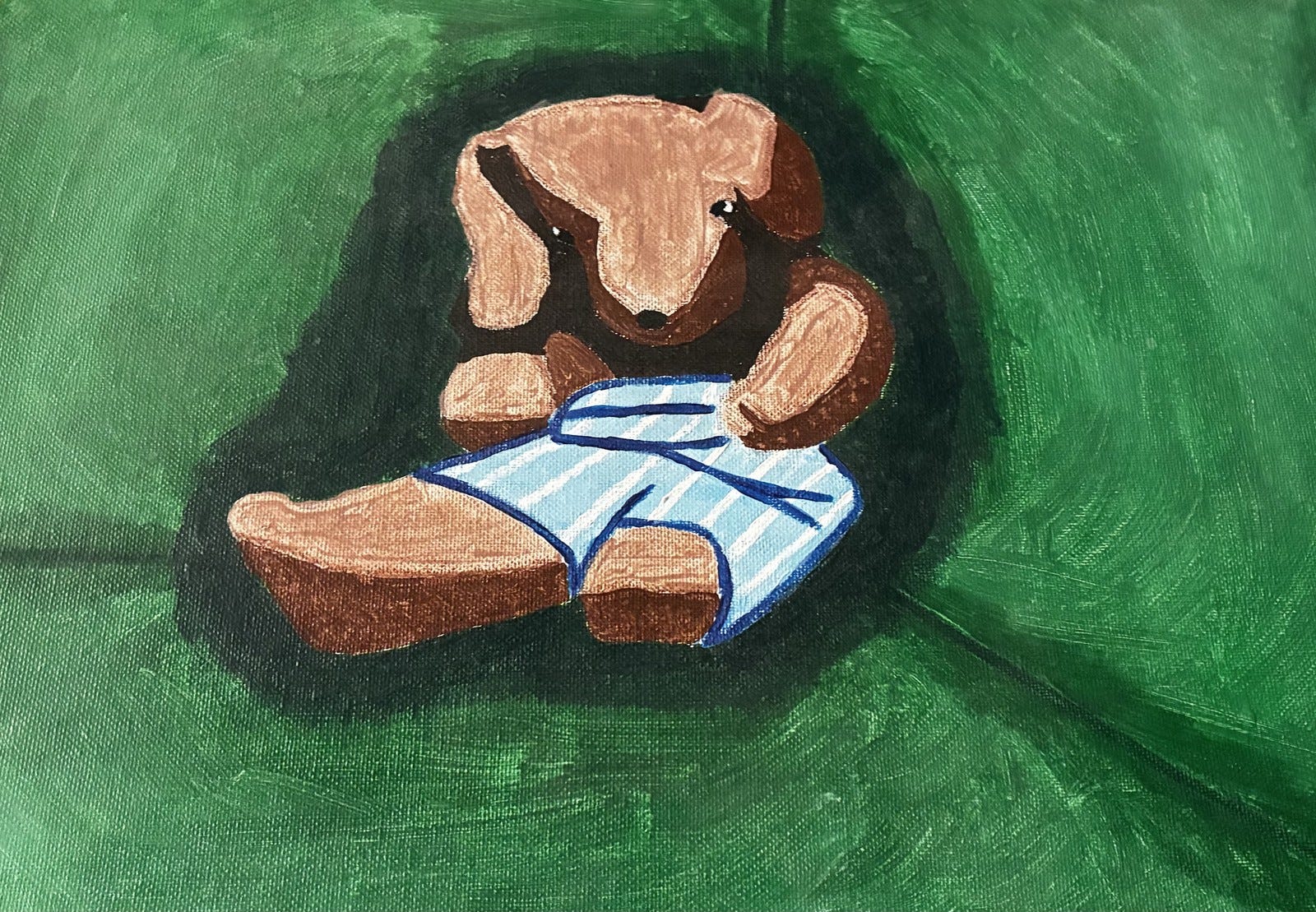
In sixth grade I drew a teddy bear.
Floppy ears, sitting in the corner of a room. I did the whole thing by hand, shading and all, and then I went back over it with paint and spent a long time trying to work out how to get it just right and how I saw it in my mind. I have no idea why I got so obsessed with it. Nobody asked for it.
What I do remember is how it felt. Alive. Expansive. Like something I had no other way of saying was finally getting out.
It’s still at my childhood home and it’s probably the best thing I’ve ever made.
And I never drew anything again.
That’s the part I’ve been reflecting on recently. Not that I stopped.. people stop doing things all the time, but that there was no moment. No teacher told me I wasn’t good at it. Nobody laughed. I didn’t decide, on some specific Tuesday, that I was done with drawing. I just look up now, thirty-odd years later, and there’s a painted teddy bear in my childhood home and nothing after it.
So what happened? Where does a thing like that go? Does it leave, or do you put it down somewhere and forget which room?
I just stopped.
I only noticed the next part recently, and it’s the reason I’m writing this down at all.
Something else stopped that same year.
I sang. Properly, out loud, in front of people. Solos at church, solos at school, all the way through elementary. I wasn’t nervous about it, which is the detail that gets me now. I genuinely wasn’t nervous, because nobody had yet told me whether I was any good. That information simply hadn’t arrived. So I sang.
And then my voice changed, the way everybody’s does. You wait, and a new one shows up, and you learn to sing with the new one.
For years that was the whole explanation I had. My voice broke, so the singing stopped.
It’s a nice story to tell myself and it isn’t true. The voice changing is just a timestamp. Sixth grade is when all of it arrives at once: comparing yourself to the people around you, working out what the room thinks of you, shame, ego, the first bully, the first real embarrassment. The voice changing handed me a reason to stop singing in front of people. Everything else made the reason stick, and then quietly applied itself to the drawing too.
That’s why they went together. It was never about talent, or about puberty. It was the year I worked out that I could be judged. Not the drawing - me. How I talked. Who I sat with. How I did in school, whether I was any good at sports, where I landed in whatever order middle school had settled on that week. And the things I made were not separate from that. They were a core part of me, so they went in with everything else.
For a long time I filed both of these under “things I used to be able to do.” Like they were talents with expiry dates. The drawing went, the singing went, and then I got on with a career in software and stopped thinking about either of them for two decades.
But that’s not what happened. I didn’t lose the drawing. My hands work. I didn’t lose the singing as I still sing in the car like everyone else, badly and with total commitment.
What I lost was the part where it didn’t have to be good. And with it the feeling, because the feeling only ever turned up when the thing didn’t have to be good.
The drawing didn’t leave. The permission did.
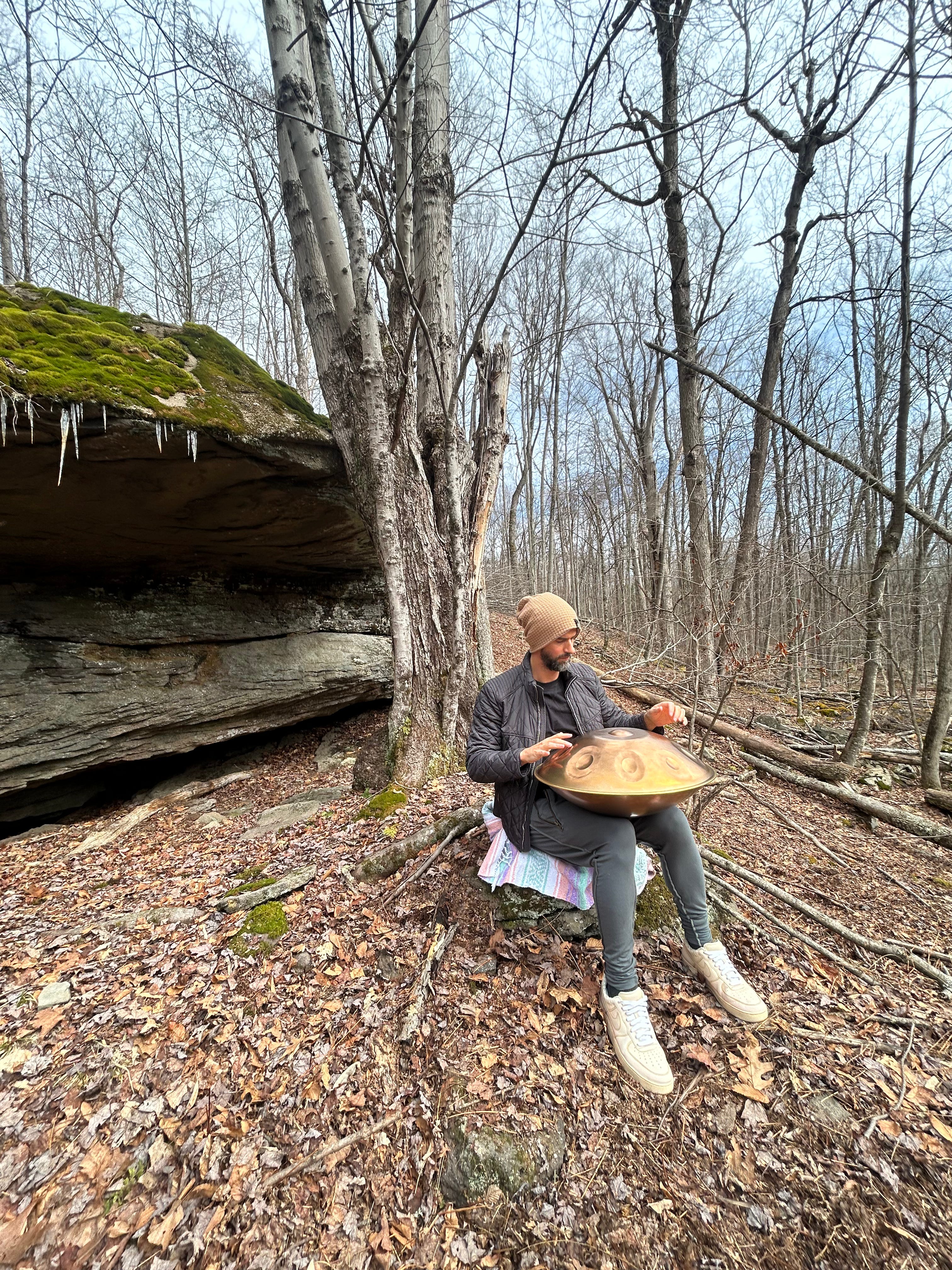
I’ve been thinking about this because I play the handpan now. And I’m trying to write more.
Nine months in. I write a new pattern most days, and honestly that undersells it - every single time I sit down, something comes out that wasn’t there before. I don’t plan any of it. I get into the flow and it arrives. That is the whole reason I play.
If you go and watch the handpan players I learn from on YouTube, they’re somewhere I’m not yet, and I’m aware of it every time I sit down.
And I couldn’t be more excited to close that gap. Not so I can be them. Because of what I know it will let me give, and do, once I’m there. And funny enough, I’ve already started.
For a while I thought of the handpan as a new thing. Something I picked up late and bolted onto a life that already had a shape.
It isn’t new. It’s the teddy bear.
I’ve described creativity before as an onion. The first layer is creating just to create - no purpose, no outcome, no practical use, it just comes from somewhere inside you. The second is creating for yourself with intention, which arrives once the first layer has reminded you how good that feels and you go back in reaching for something specific. The third is creating for other people, once you’ve built the rituals and the confidence to show it.
In sixth grade I did the first two without knowing they had names. I drew that bear because I wanted to draw it. All that shading, for nothing. And then I went back over the whole thing with paint, and that was a different act entirely. That was intention. By then I knew what I wanted it to be.
I did it again in tenth or eleventh grade, when I wrote a children’s book. Playing Chess with Dragons. I never really showed it to anyone, and that was never the point of writing it.
And that is exactly what the handpan is. Something arrives that wasn’t there before, and then I go back in and shape it. The same two layers, thirty years later, on a piece of metal instead of paper.
But the layers aren’t really what connects them. What connects them is how it feels, and that part hasn’t changed at all. Alive. Expressive. Connected to something. Expansive. In flow, and full of a purpose that has nothing to do with being useful.
That feeling is the thread. The same one in sixth grade with a pencil, in high school writing about dragons, and now on a piece of steel. I never had a word for it. I just knew I wanted to be in it.
There is one thing the bear never got, though, and it’s the part I didn’t see coming.
I picked up the handpan because I’d finally found an instrument that could make the sounds and the emotions I was holding come out sounding the way they actually felt. That was the whole reason. And because that was the reason, I practiced - not out of discipline, but because I wanted more of it.
The practice gave me range. The range meant more of what I actually meant started making it out intact. Which made me want to play more. Which gave me more range.
It’s recursive. Every turn of it makes the next one easier, and nine months in it hasn’t stopped.
The bear only ever got one turn.
So nothing was ever missing. What I lost was not the ability to do the first two. It’s that somewhere in there I started demanding the third one up front. That a thing be worth showing before I’d let myself make it at all.
You can’t run it in that order. Nothing survives it.
What changed isn’t that I got braver. It’s that I stopped asking the third layer for permission to do the first.
That is easier somewhere nobody is grading. I didn’t have anywhere like that for a long time, and I want to be honest that I had a lot of sophisticated language for what I thought was wrong with me before I worked out that it was that simple. I could talk fluently about burnout and identity and nervous system regulation. The actual problem was that every room I was in was grading. Nothing is wrong with me.
A room where the thing you make doesn’t have to be good yet.
Most adults don’t have one.
I shared a clip of Gabor Maté on regret this week, and what I wrote underneath it was that play is core to who we are. It sparks creativity and healing, and connects you better to yourself and to other people.
I believe that. And I’d add the uncomfortable half of it, which is what this whole essay is really about.
Almost nobody stops playing. We reclassify it.
It becomes output. And output gets a grade.
Two things I want to say carefully, because this is where these essays usually go wrong.
The first is that I don’t think anything is broken in you, or me. That’s the standard move in this genre… to find the wound, name it, sell the repair or heal it. I don’t think your creativity is injured or locked away or in need of healing. I think it’s sitting in there perfectly content and the door has been open the entire time. What’s missing isn’t repair. It’s permission. Not from me…but from yourself. It’s a reason to come out, and someone on the other side of the door who isn’t holding a scorecard. You.
The second is that I’m not telling you to draw. Genuinely. If you have no interest in drawing, don’t draw. That’s not the question.
The question is what else you stopped.
Because the teddy bear is not really about art. Almost everyone I talk to has a version of it. Somebody was obsessed with something at eleven, and did it constantly, and then didn’t. Model airplanes, writing terrible fantasy novels, taking radios apart, making up games with rules that made no sense. And when I ask about it, something happens to their face. There’s a half-second where they’re eleven again and then they say “oh god, I haven’t thought about that in years,” and laugh, and they light up like a tacky Southern Christmas tree.
I’ve started paying attention to that half-second. It’s the most reliable thing I know.
It’s the feeling, still in there, with nothing to do…just WAITING for the opportunity to come out and play.
Three from the episode that didn’t make a post.
I once wrote a computer virus and sent it to my brother at NC State. This was 1999, over 28.8K dial-up. He double-clicked a picture, nothing appeared to happen, and then a few moments later his printer - in another city - printed the words BROWNIES ARE DONE and his CD tray slid open. Still the coolest thing I’ve ever done from a technical standpoint. He was not impressed. He was furious, because it was really wrong and we both knew it, and I never did work out how to remove it.
I also used to draw tournament brackets for fun. Not fill them in… draw them. Sixty-four team March Madness fields, World Cup groups, and crucially the losers’ bracket, which are their own geometry problem because eventually they have to feed back into the winners bracket. I’d run the simulations in my head and sketch out who ended up where. Which, now that I write it down, is obviously the same activity as building an imaginary world and populating it with people. I just didn’t have a word for it at eleven. I did the same thing with my action figures, spread out all across my room. Left from one day to the next as I played out intricate storylines with my imagination.
And I made Pong. My first ever game, for a school project. Which is why the first thing I made with AI at Eleven Dunbar was Pong again, thirty years later. I didn’t plan that either.
I still think it’s the best thing I ever made.
Not because of how it looks. Because of how it felt to make it.
And because I can feel exactly that, right now, with my hands on something else entirely - my handpan.
This week on Levity Field, Gerhard and I talked about what we each made as kids before anyone told us whether we were any good at it and what we’re each curious about now that has no obvious use. It’s one of my favorite conversations we’ve had.
Justin Davis. 20+ years in tech and AI, six exits and one failed startup. In my early 40s, I finally took a year off and that’s when the actual work began. I co-host Levity Field with Gerhard Molin - a podcast about lightness, for moments that feel heavy. We also built Eleven Dunbar, a community for people who want to make things again.